Leave Entitlements and Holidays
Posted on March 23, 2020

Date Published: 23 March 2020
Authors: Pradeep Kumar Singh, Bill Jamieson, Wong Pei-Ling and Marvin Chua.
All employees are entitled to a minimum amount of annual leave if they meet the requirements under section 88A of the EA.
An employer must pay an employee the employee’s gross rate of pay for every day of paid annual leave.
Under section 88A of the EA, an employee who has served his employer for at least 3 months shall be entitled to paid annual leave of 7 days in respect of the first year of continuous service with the same employer, and one additional day for every subsequent year with the same employer, up to a maximum of 14 days’ annual leave. An employee who has served an employer for a period of at least 3 months, but has not completed a year of continuous service, is entitled to annual leave in proportion to the number of completed months of service in that year.
Annual leave is in addition to rest days, public holidays, sick leave and child care leave.
If an employee is dismissed on any ground other than misconduct before the employee has taken all of the employee’s paid annual leave, the employer must pay the employee the employee’s gross rate of pay in respect of every day of that leave not taken by the employee.
An employee forfeits his/her entitlement to annual leave if the employee is absent from work without the employer’s permission, or without reasonable excuse, for more than 20% of the working days in the months or year (as the case may be) in which the employee’s entitlement to annual leave accrues.
In the case of workmen (whose monthly salary does not exceed S$4,500) and non-workmen (whose monthly salary does not exceed S$2,600), annual leave has to be taken not later than 12 months after the end of every year of continuous service and any employee who fails to take that leave by the end of such period shall cease to be entitled to the leave. If the employee chooses not to take leave he will not be able to claim any compensation in lieu of such leave not taken.
Breach of section 88A results in the commission of an offence. A first-time conviction under this section will result in a fine not exceeding S$5,000, and a second or subsequent offence will result in a fine not exceeding S$10,000 or imprisonment for a term not exceeding 12 months or to both.
An employee is entitled to paid sick leave under the EA if:
This does not apply to any medical treatment which is for cosmetic purposes.
If the employee fails to duly notify or attempt to notify the employer within 48 hours after its commencement, or if the sick leave is not duly certified, the employee will be deemed to be absent from work without permission or reasonable excuse.
The number of days of paid sick leave a new employee is entitled to depends on his service period:
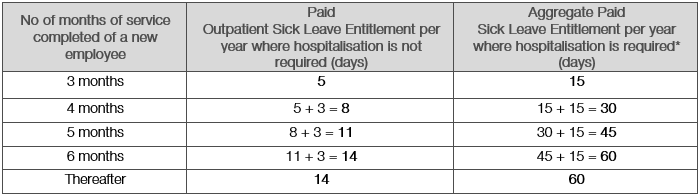 *An employee is hospitalised if the employee is under quarantine or warded in a hospital —
*An employee is deemed to be hospitalised (and entitled to paid hospitalisation leave) if he/she is certified by a doctor to be in need of hospitalisation. He does not necessarily have to be warded in a hospital. This covers the period of recuperation after being discharged.
The amount of paid outpatient and hospitalisation sick leave that an employee can take is capped at his sick leave entitlement (as indicated in the right-most column of the table above).
If an employee has served the employer for at least three months, the employer is legally obliged to bear, or to reimburse the employee for, the medical consultation fee if the medical practitioner is appointed by the employer or is a medical officer; and after the examination, the employee is certified by the medical practitioner to be entitled to paid sick leave. No such liability will be incurred where the medical consultation is for cosmetic purposes. For other medical costs, such as medication, treatment or ward charges, the employer is obliged to bear such costs only to the extent that medical benefits are provided for in the employee's employment contract, or in the collective agreement signed between the employer and the union.
If an employee is on paid hospitalisation leave, his employer has to pay him at his gross rate of pay. If an employee is on paid outpatient sick leave, his employer has to pay him at his gross rate of pay, excluding any allowance payable in respect of shift work.
An employee is not entitled to paid sick leave on the following occasions, even if he is given medical leave by the doctor:
However, he is entitled to claim for the medical examination fee. His entitlement to claim for other medical expenses would depend on the medical benefits provided in his employment contract or the collective agreement signed between the employer and the employee’s union.
Part IX of the EA and Part III of the CDCSA provide Government-paid maternity leave, benefits and protection for eligible employees.
The CDCSA covers all parents of Singapore citizens, including managerial, executive or confidential staff. Under the CDCSA, a female employee is generally entitled to maternity leave benefits if:-
(Note that a self-employed female may be entitled to Government-paid maternity leave if she has been carrying on her trade, business, profession or vocation for at least 3 continuous months and has lost income during the maternity leave period).
Maternity leave benefits are applicable to both married and unwed mothers.
For female employees not covered under CDCSA, they may be entitled to maternity leave benefits if they fall within the scope of the EA.
A CDCSA eligible employee is entitled to absent herself from work for a total of 16 weeks of maternity leave that may be taken in one of the following manner:
Under Part IX of the EA, employees covered by the EA, but not under the CDCSA, are entitled to a total of 12 weeks of maternity leave that may be taken in one of the following manners:
If the employee qualifies for Government-paid maternity leave under the CDCSA, she will be paid by the employer during the entire 16 weeks of maternity leave, regardless of the birth order of the child. The employer is entitled to reimbursement from the Government for the last eight weeks for the first and second births and all 16 weeks for the third or subsequent births (as well as any CPF contribution made by the employer in respect of such payment which is not recoverable from the employee’s wages). However, all reimbursements shall not exceed a total of S$20,000 for the first and second births, and S$40,000 for the third and subsequent births.
If the employee does not qualify for maternity leave under the CDCSA but qualifies for maternity leave under the EA, the employer is required to continue paying an employee her usual salary (i.e. monthly gross rate of pay, including allowances) for the first eight weeks of maternity leave if:
For maternity leave under the EA, payment by the employer beyond the first eight weeks is voluntary and subject to contractual agreement.
Employers are prohibited from dismissing an employee who is on maternity leave. An employer who does so is liable to a fine and/or imprisonment.
If a notice of dismissal is given without sufficient cause at any time of the employee’s pregnancy (as certified by a medical practitioner before the notice of dismissal is given), the employer must pay her the maternity benefits she is otherwise eligible for.
If the employee is retrenched within three months of her child’s birth, the employer must pay her the maternity benefits she is otherwise eligible for. This payment is in addition to any retrenchment benefit which the employee is entitled to.
An employer cannot employ an employee at any time during the four weeks immediately following her child’s birth.
An employer cannot contract out of their obligation to provide the maternity benefits.
Under the CDCSA, a male employee is entitled to Government-paid paternity leave benefits if:-
Adoptive fathers who meet the following requirements are also entitled to Government-paid paternity leave for all births where:
(Note that a self-employed man may be entitled to Government-paid paternity leave if he has been carrying on his trade, business, profession or vocation for a continuous period of at least 3 months preceding the date of the birth of the child, and has lost income during the paternity leave period).
A CDCSA-eligible employee is currently entitled to 2 weeks of paid paternity leave as follows:
The paternity leave entitlement is funded by the Government and capped at S$2,500 per week (inclusive of CPF contributions – see section 16 of this guide).
Under the CDCSA, male and female employees are entitled to childcare leave benefits if:-
(Note that those self-employed may be entitled to childcare leave if: (i) he/she has been carrying on his trade, business, profession or vocation for a continuous period of at least 3 months, (ii) ceases to be actively engaged in his trade, business, profession or vocation for childcare purposes for not less than 4 days; and (iii) has lost income during the childcare leave period).
For employees not covered under the CDCSA, they may be entitled to childcare leave benefits if they fall within the scope of the EA.
Regardless of the number of children he/she may have, a CDCSA eligible employee is entitled to:
‘Childcare leave’ is capped at 42 days for each parent in respect of any qualifying child, and all yearly childcare leave entitlement must be expended by the end of that year.
An employee with children in both age groups (i.e. below 7 years as well as between 7 and 12 years) will have an entitlement of 6 days per year in total for both ‘childcare leave’ and ‘extended childcare leave’.
For employees not covered under the CDCSA but covered under the EA, they may be entitled to 2 days of childcare leave if they have a child below 7 years of age during the relevant period and have worked for the employer for at least 3 months.
If the employee qualifies for childcare leave under the CDCSA, the employee will be paid by the employer during the leave period and the employer is entitled to reimbursement from the Government for 3 days of childcare leave if the employee is granted 6 days of childcare leave. Payments are capped at S$500 per day (inclusive of CPF contributions – see section 16 of this guide).
If the employee qualifies for extended childcare leave only, the employee will be paid by the employer during the leave period and the employer is entitled to reimbursement from the government for the 2 days of extended childcare leave. Payments are capped at S$500 per day (inclusive of CPF contributions – see section 16 of this guide).
If the employee does not qualify for childcare leave under the CDCSA but qualifies for childcare leave under the EA, the employee will be paid by the employer for the 2 days of childcare leave.
Under the CDCSA, male employees are entitled to shared parental leave benefits if:-
(Note that a self-employed man may be entitled to shared parental leave if: within 12 months commencing on the date of the child’s birth, he ceases to be actively engaged in his trade, business, profession or vocation during one or more than one period; and has lost income during the shared parental leave period).
In addition, employees or self-employed men who are adoptive fathers may be entitled to share their wife’s adoption leave benefits if:-
An eligible employee whose child is born on or after 1 July 2017 is entitled to absent himself from work for a total of 4 weeks of shared parental leave that may be taken in one of the following manner:
The shared parental leave entitlement is funded by the Government and capped at S$2,500 per week (inclusive of CPF contributions – see section 16 of this guide).
Under the CDCSA, employees who are adoptive mothers are entitled to adoption leave benefits if:-
(Note that a self-employed woman may be entitled to adoption leave if: within 12 months commencing on the date of the child’s birth, she ceases to be actively engaged in her trade, business, profession or vocation during one or more than one period; and has lost income during these period(s)).
An eligible employee whose formal intent to adopt a child is on or after 1 July 2017 is entitled to absent herself from work for a total of 12 weeks of adoption leave that may be taken in one of the following manner:
The adoption leave entitlement is funded by the Government and capped at S$10,000 per every 4-week of leave taken (inclusive of CPF contributions – see section 16 of this guide).
If the employee qualifies for adoption leave under the CDCSA, she will be paid by the employer during the leave period and the employer is entitled to reimbursement from the Government for the last eight weeks for the first and second children and all 12 weeks for the third or subsequent children. However, all reimbursements shall not exceed a total of S$20,000 for the first and second children, and S$30,000 for the third and subsequent children (inclusive of CPF contributions – see section 16 of this guide).
All male Singaporean citizens and second-generation permanent residents who have reached the age of 18 are required to render National Service. The employer is obliged to allow the male employees to perform National Service. No employer shall dismiss an employee solely or mainly by reason of any duty or liability which that person is, or may become, liable to perform or discharged by reason of his being liable to be, called up for National Service.
When a person performs such a service, in so far as his civilian remuneration is reduced, that person may claim a reimbursement in respect of that reduction from the designated authority, less any service remuneration which he may get in respect of that service. If, instead of reducing the civilian remuneration, the employer continues to pay the employee during the period of service, the employer can in turn claim reimbursement from the designated authority provided certain conditions are satisfied.
All employees are entitled to a paid holiday at his gross rate of pay on a public holiday, subject to the following:
Employees to whom Part IV of the EA does not apply (i.e. all Managers and Executives, workmen earning more than S$4,500/month, and non-workmen earning more than S$2,600/month) who work on a public holiday shall be paid the gross rate of pay for that day and may be given the following: a day off in substitution for that holiday or an extra day’s salary at the basic rate of pay, or time-off for a number of hours (as parties agree or if there is no such agreement, either 4 hours off if the employee worked 4 hours or less on the Public Holiday or the entire day if he worked more than 4 hours).
Please note that this section of the Employment Law Guide is a summary provided for general information purposes, aimed at aiding understanding of Singapore’s employment law as at the date of writing. It is not exhaustive or comprehensive and reading this memorandum is not a substitute for reading the text of the various statutes to fully understand the extent of the obligations owed. This guide should also not be relied upon as legal advice.
General disclaimer |